Symposium:
Imag(e)ining Futures – Panel III
6.11.26
Panel III, ‘Prototypes and other tools for thinking about the future’, focuses on design artefacts (Entwürfe) as a tool and the working methods of designers. Following an inspiring keynote talk, a series of parallel workshops will be offered. These will take a hands-on approach to exploring the extent to which prototypes, scenarios and speculative design processes generate new knowledge. They will examine how designs make assumptions visible and alternatives testable.
Information on further workshops and registration will follow shortly.
Click here for the symposium programme overview.
Moritz Koch
Gentle Systems Berlin (Keynote)
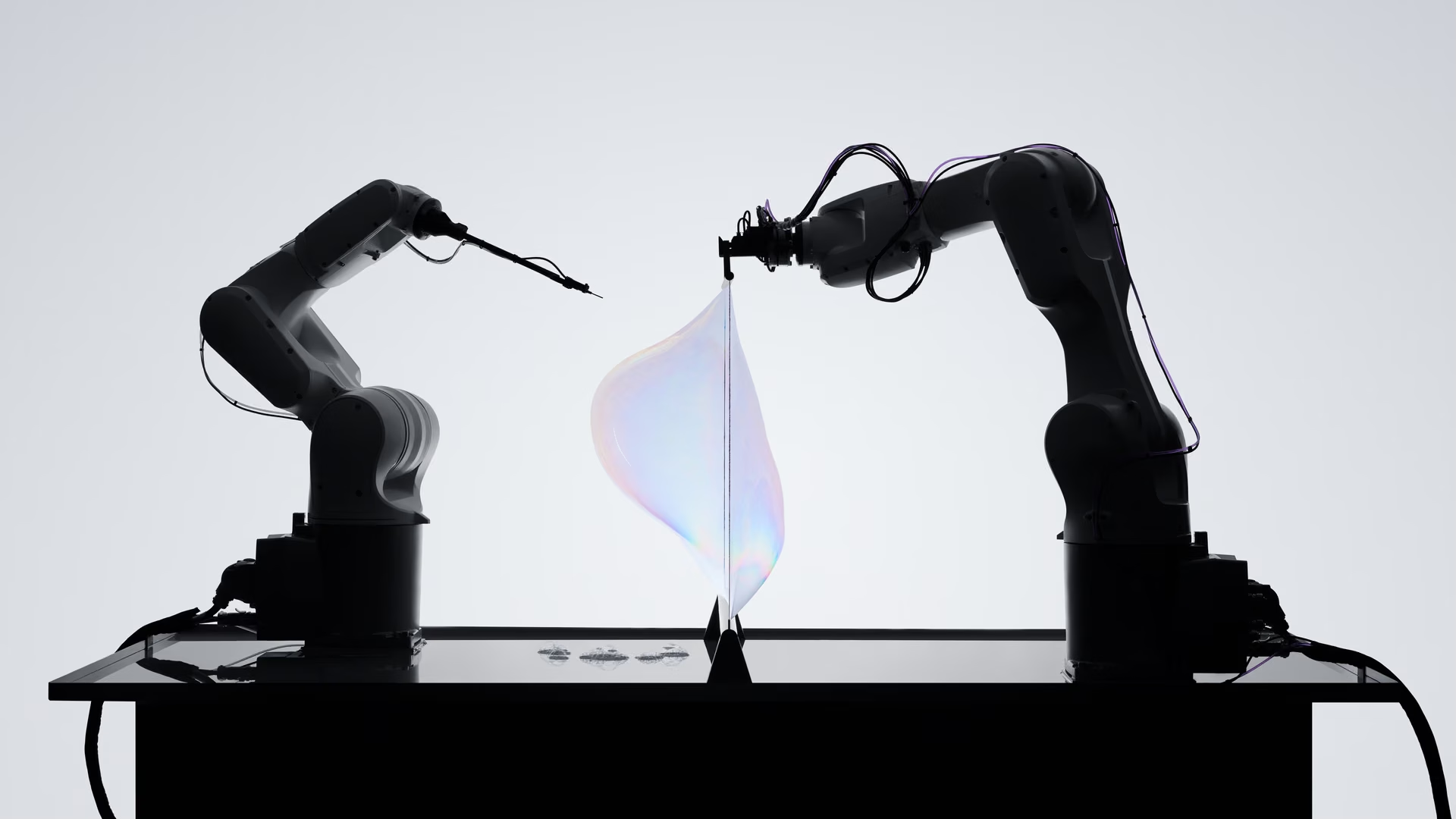
About Thinkers and tinkerers. Gentle Systems ↗ blends engineering, storytelling and design to help bold ideas move from concept to the world. The Berlin based studio don’t just imagine future scenarios—they help international clients to step into them, with new tools, systems and experiences.
Their philosophy prioritizes unconventional, sensitive thinking, taking care to shape technology for people and place. Innovation is seen as a practice of curiosity and experimentation that preserves heritage in the exploration of what could be.
Andreas Muxel (Technical University of Applied Sciences Augsburg)
Positive Futures 2046: Living with Machines
Workshop I
This workshop will be held in German.
What is this workshop about?
In this hands-on workshop, we explore the future of living with machines not as a technical challenge to optimize, but as a space for imagining positive, desirable ways of co-existence. Instead of asking, “What problems can technology solve?” we ask, “What kinds of lives do we want to live in 2046, and what role might machines play in supporting them?” Using Design Fiction, Techno-Mimesis and role-play, we will create and experience utopian futures that focus on human experiences, needs, and values, while also surfacing tensions, contradictions, and ethical questions.
What will we be doing?
- Designing speculative technology concepts
- Building simple props and performing role-play scenarios
- Reflecting critically from human and non-human perspectives
No prior experience with design fiction, acting, or performance is required, just curiosity and a willingness to experiment.
Eva Katsaiti (University of West Attica)
From Wound to Word to World
Workshop II
This workshop will be held in Englisch.
What is this workshop about?
This workshop invites participants to explore their emotional relationship with gender-based violence through a structured process of naming, transformation, and creative action. In the first stage, participants are asked to identify three words that capture what they feel when they encounter or think about gender violence — raw, honest, negative words drawn from their own lived experience or awareness. These might be feelings like shame, helplessness, or rage. They are then asked to find three antidote words — the emotional states they wish to move toward, such as dignity, solidarity, or courage. Finally, and crucially, participants reflect on what they would need — in terms of support, resources, community, or structural change — to actually travel from the negative words to the positive ones. This third step turns the exercise from personal reflection into a form of collective knowledge production, surfacing not just feelings but the conditions required for genuine transformation.
The second thread of the workshop runs parallel: participants create collages using images drawn from popular culture and mainstream magazines. Rather than accepting the visual language that popular media offers around gender and violence, they are asked to cut, rearrange, and reframe these images — subverting their original meaning to construct new visual narratives that move from harm toward justice, care, and agency. This act of physical making mirrors the emotional work being done with words: both are practices of reframing, of refusing the dominant story and prototyping an alternative. Together, the word exercise and the collage-making form a two-track methodology — one verbal, one visual — that allows participants to engage with a difficult topic through multiple modes of knowing, making the workshop both accessible and generative across different learning styles and lived experiences.
What will we be doing?
- Addressing negative emotions using verbal and visual methods
- Working with ‘antidote words’ and reflecting on the conditions necessary for change
- Creating new visual narratives of justice and care
No prior experience is required.
Julian Moder (Technical University of Applied Sciences Würzburg-Schweinfurt)
Thinking, Prompting, Drawing: Generative Systems in the Design Process
Workshop III
This workshop will be held in German.
What is this workshop about?
We have always imagined images of the future. What is new is that these images now emerge on demand, instantly and convincingly, sometimes from a single sentence of text. This is changing the very way we envisage what lies ahead. In this workshop, we will design a place of the future and observe what happens to our ideas when a generative system thinks or draws alongside us. Four groups will approach the same task in different ways, exploring a spectrum between their own imagination and the support provided by generative systems in terms of ideas and images. By the end, we will have gained a clearer understanding of where our own creative input makes an impact and where the machine shapes the design.
What will we be doing?
- Designing a ‘future space’, with each group following its own path
- Comparing the results and analysing them together
- Exploring the question of who actually owns the future we have created
No prior experience is required, neither in drawing nor in using AI tools. All you need is your laptop and curiosity about what can emerge from the interaction between the mind, the machine and the hands.
Prof. André Rösler, Dr. Beatrice Barrois (Technical University of Applied Sciences Würzburg-Schweinfurt)
Drawing Forward – Comics as a Narrative Experiment
Workshop IV
This workshop will be held in German.
What is this workshop about?
This workshop focuses on a creative exploration of comics as a narrative experiment. Questions about the future are explored through both drawings and text to encourage speculative thinking and give voice to inner, emotional visions of the future. Drawing freely on the principle of montage, we’ll then develop short narratives that articulate utopian visions of the future rooted in deep-seated expectations and needs, thereby commenting on what lies ahead for all of us in ways that are serious, whimsical, humorous, or absurd.
What will we be doing?
- Experience drawing as an experimental exploration
- Play with words and text as a process of discovery
- Use montage as a narrative tool for visions of the future
No prior knowledge is required—just a desire to engage in creative processes.
Tessa von Both (Technical University of Applied Sciences Würzburg-Schweinfurt)
VorBilder – Visual References, Shared Imagination
Workshop V
This workshop will be held in German.
What is this workshop about?
The power of imagination enables us to bring the absent into the present. It determines what appears before our mind’s eye and, consequently, what we consider possible. It is relevant not only to the selection of references, but also to their evaluation: What is considered successful? What convinces others? What standards do we share? VorBilder (A play on the german word ‚Vorbild‘ combining ‘Vor’ (pre) and ‘Bild’ (image), meaning ‘role model’, ‘preconceptions’ or ‘ideas’) are therefore never neutral; they represent attitudes, positions and decisions. For design, this means we navigate between visual inspiration and taking our cue from designers whose work we regard as exemplary – whether in terms of form, content or politics. You will design your own zine, compiling visual material. The focus will be on the selection and combination of VorBilder. The selected images can open up both contemporary and future perspectives.
The boundaries of the imagination frame what we can conceive and express. This makes the conscious collection and focused compilation of VorBilder all the more important. Discussing them can expand the imagination: new images become conceivable, new connections possible.
What will we be doing?
- Designing a zine using images you bring along
- Selecting and combining visual references, and reflecting on which images, perspectives and references shape and expand your own creative thinking
Prof. Sydney Craig, Nicholas Witten (Indiana University)
Sensory Futures: Non-Visual Prototyping as Epistemic Practice
Workshop VI
This workshop will be held in English.
What is this workshop about?
Future visions in design are overwhelmingly visual—dominated by screens, render aesthetics, and clean dashboards. Yet, visual media often flattens complex futures into passive representations, masking how technologies feel, sound, or physically impact us. This hands-on workshop reframes sensory engagement (tactile, olfactory, acoustic) as an epistemic tool—a method for generating new knowledge and surfacing implicit assumptions about future co-existence.
Grounded in theories of embodied interaction and tacit knowledge, participants will bypass visual representation to prototype “sensory patches” of alternative futures. By shifting from seeing the future to sensing it, we test how non-visual dimensions reveal hidden ecological costs, social friction, and emotional realities that are not necessarily communicated in visual design.
What will we be doing?
- Sensory Prototyping: Construct multi-sensory artifacts (combining textures, acoustic elements, ambient scents, etc.) representing micro-scenarios from 2050.
- Blind Experience & Epistemic Audit: Participants evaluate each other’s prototypes with eyes closed, documenting the non-discursive knowledge, ethical tensions, and felt realities the objects evoke.
No previous experience is required. If you have them, please bring along hand tools such as scissors, a craft knife, a ruler, pens, small cutting mats, a.o.
Prof. Moritz Schwind (OHM Nürnberg)
Algorithmic Design – Form as a Conceptual Space of Possibilities
Workshop VII
This workshop will be held in German.
What is this workshop about?
In this practice-oriented workshop, we will explore generative AI not as a fixed set of tools to be mastered, but as a space in which we can investigate the boundaries between combinatorial, exploratory, and transformative creativity, as defined by cognitive scientist Margaret Boden. Rather than asking, ‘What image can I generate?’, we will ask, ‘What conceptual space of possible outcomes can be defined by a trained model and its parameters, and what happens when we reach its limits?’ Using a series of pre-built, ready-to-use Colab notebooks, we will first explore a generative system within its defined parameters. Then, we will deliberately break, bend or rewrite these parameters to see what new possibilities arise.
What will we be doing?
- We explore a pre-built generative system by varying its parameters, such as prompts, seeds and settings, within a fixed framework.
- We identify some of the system’s core rules and intervene in them in a targeted manner to achieve new and unexpected results.
- We consider where exploration ends and genuine transformation begins, and where generative AI itself fits within Boden’s categories.
No prior knowledge of generative AI or programming is necessary. All you need is a computer with an up-to-date web browser, as well as two accounts: a Google account for Google Colab ↗ and a Hugging Face ↗ account. The free versions of both are sufficient. No software needs to be installed in advance.