Siebensachen
Things and invisible things
»I said I’d take the fountain pen, but I never used it. It has a super-thick nib, which is typical of my father — he liked things to be flashy and super-thick. The letters ‘a’ and ‘e’ are almost completely filled with ink. Then I went to Karstadt and asked how much it would cost to replace the nib with an M. The saleswoman said, ‘160 marks.’ I asked how much the whole fountain pen would cost. She replied, “380 marks.” Gulp! I would never buy a fountain pen for 380 marks. But I kept it anyway. I thought, ‘It’s a good fountain pen. Now you have it, and it belonged to Dad.’ But it has a thin nib now. This is my nib now; it’s one that I can write with. I can’t write with the other one — the thick nib. I thought it would be a shame to just leave this valuable fountain pen lying around unused. So I decided to use it too [1]« (Loos & Glück, 1962, p. 203)
They are there. Often unnoticed. Yet, helpful. They are the things in everyday life that we have become so accustomed to that we no longer even notice them. Little things. Our favourite things. They are so commonplace that we almost forget they were once designed. They are so commonplace that we almost forget to ask whether they could be designed differently! So what are the stories told by the things around us? About ourselves? About themselves? About others?
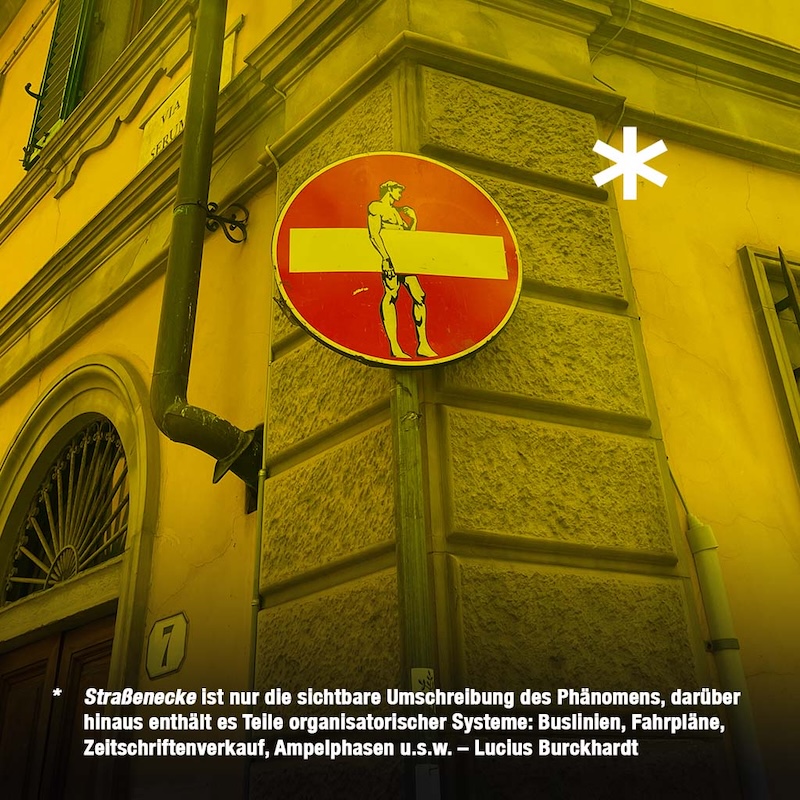
When Lucius Burckhardt writes that design is invisible, he is not referring to the most comfortable use of a design, but to its social context: after all, what use is the most beautiful tram if it does not run at night? According to this understanding, designers should not solely strive to adorn the most functional object with formal criteria of beauty. Rather, they should aim to create designs »that are capable of consciously taking into account invisible overall systems consisting of objects and interpersonal relationships [1]« (Burckhardt 2012, p. 25).
This foundation class focuses on everyday objects and their seemingly invisible framework conditions. Step by step. Hands-on approach from exploring a context to the final design. No prior knowledge of three-dimensional design is required. As always, students have a wide range of media to choose from. Nevertheless, students will learn how to develop and communicate design solutions using various digital and analogue prototyping techniques. Aspects of manufacturing, usability and product life cycles may also be explored. To this end, we will take a closer look at plywood (Formholz). We have planned an excursion to the Kohl veneer factory in Karstadt, as well hands-on experience with workshop master Steffen Töpfer.
I will be happy to answer any questions about the course online in my Zoom on Tuesday, September 23, 2025, between 11:00 a.m. and 12:00 p.m.