4000 Miles (4)
Geometry of Belonging
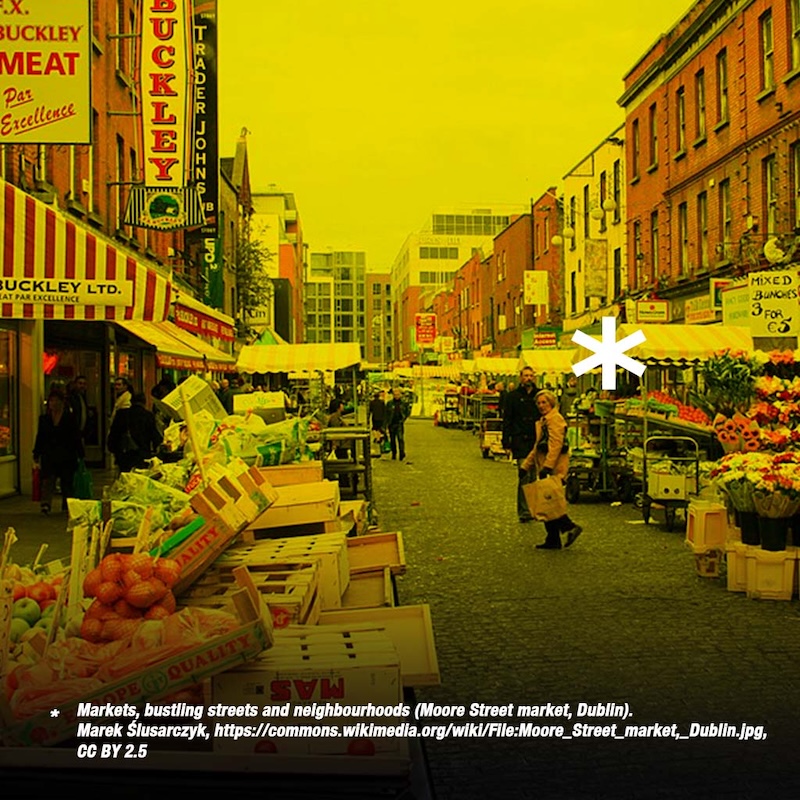
»”It’s just about coffee drinking”, they say disparagingly.
And I wanted to challenge that idea.
I mean, okay, but serving coffee is a serious urban intervention.«
— Martin Lucas in conversation with Jeanne van Heeswijk ([3] The Ontology of the Bagel Cart)
The culture of a neighborhood is “built up through millions of conversations, millions of interactions, crossing paths, and working together millions of times.” [1] Art and design, as demonstrated by the work of Jeanne van Heeswijk and others working at the intersection of community, urban change, and social care (Social Practice Art/Social Design), can contribute to “‘stimulating municipal environment’, ‘create an atmosphere and identity’, ‘react upon spatial situations’ and ‘the experience of the inner city'” [2].
We want to engage with the lived microcosm that is the neighborhood by asking questions such as, “How can neighborhoods be explored and understood through aesthetic means as a sensory experience? What does my neighborhood taste, sound, and smell like? Who lives there? How can the character of a neighborhood be captured and transported (across 4,000 miles)? How can we actively help to shape (design) our neighborhood?
4000 Miles has evolved into a fourth iteration; it is a continuing collaborative project between Prof. Sydney Craig, Herron School of Art and Design in Indiana, USA, and Prof. Judith Glaser, Faculty of Design Würzburg (THWS), Bavaria, Germany. These educators are pursuing high-impact practices for engaged learning as they develop intercultural, multidisciplinary exchanges meant to encourage and embrace a global mindset. Students from both universities will be challenged to explore the concepts of neighborhood through object studies and creative problem-solving as they work in international teams and through a variety of art and design media.
Through this collaboration, neighbourhood will be examined formally and conceptually; teams will critically and pragmatically explore its analog and digital qualities and connect these to physical experiences.
The course will culminate in a visual art and design exhibition at Faculty of Design Würzburg. As part of the course, there will be a field trip to Berlin, including a workshop at the Indiana University Gateway (11.11.–13.11.2026; arrival on the evening of 10 November).
I will be happy to answer questions about the course on Tuesday, 22.09.26 between 16:00 – 17:00 p.m. online at my Zoom. Subject to agreement, the course can be taken as a foundation project in the third semester.
—